
East Milton Sandy Soil: What It Means for Your Concrete
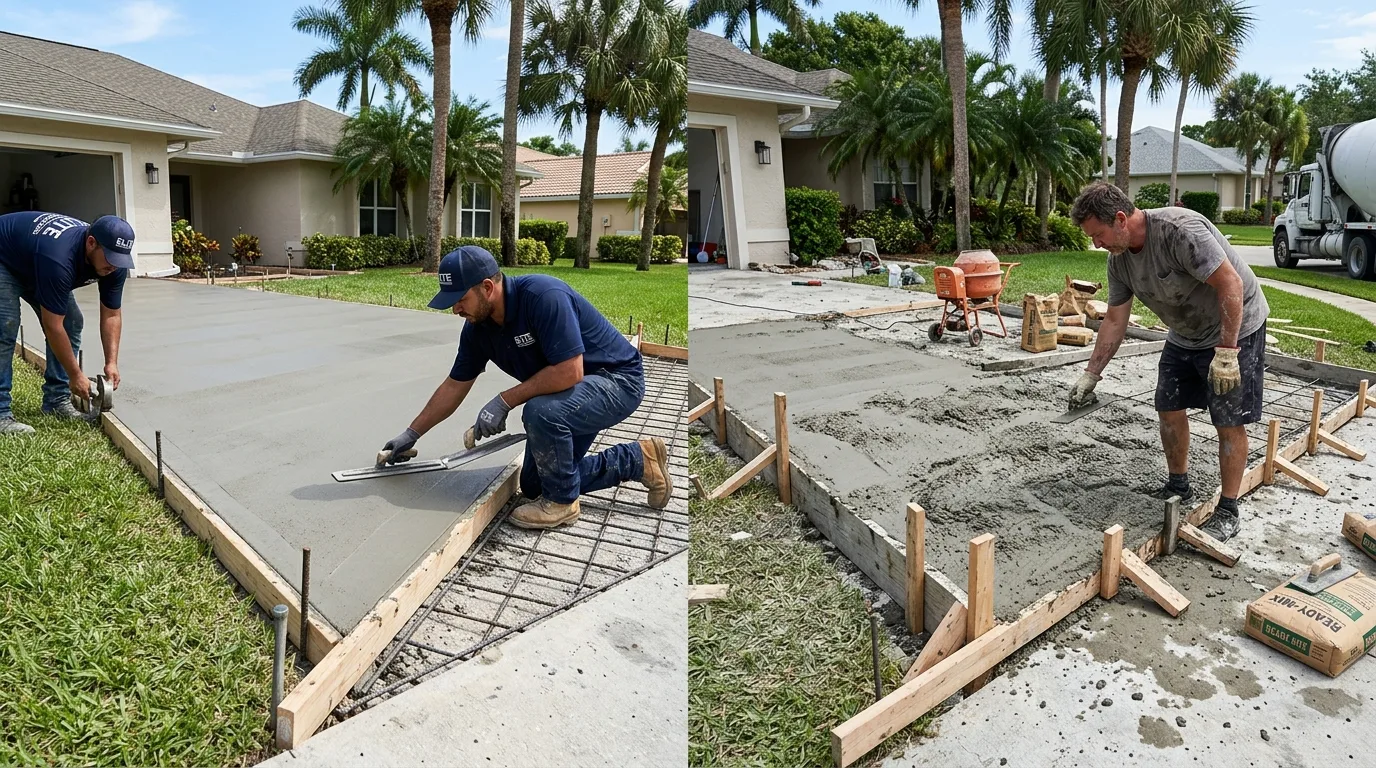
Santa Rosa County’s soils failed an estimated 15–20% of the concrete driveways installed in the region before 2010 — not because of bad concrete, but because of inadequate subgrade preparation on the county’s distinctive sandy loam soils. East Milton homeowners who know why their soil behaves the way it does make better decisions about concrete projects, choose better contractors, and avoid the most common causes of premature slab failure. In this post, we explain what the Mulat series soils of Santa Rosa County do to concrete — and what a quality installation does to counteract it.
Concrete Built for East Milton's Soil Conditions
East Milton Concrete assesses every site before pouring. Free estimates throughout Santa Rosa County.
Why Soil Composition Matters for Concrete in East Milton
Concrete is only as stable as what’s underneath it. A 4-inch reinforced concrete slab can handle enormous surface loads — but only when it’s supported by a stable, uniform subgrade. When the subgrade shifts — due to moisture change, settlement, or erosion — the slab flexes, and concrete cracks under tension. In East Milton, the soil is the primary variable that separates a driveway that lasts 30 years from one that cracks in 5.
Santa Rosa County is dominated by the Mulat series: fine sandy loam to loamy fine sand in the topsoil, transitioning to sandy clay loam at depth. These soils have two characteristics that directly affect concrete performance. First, they compact inconsistently — they can appear stable during dry conditions but lose significant bearing capacity when saturated. Second, they drain quickly at the surface but retain moisture at depth, creating conditions where the upper portion of the sandy soil can shift while the lower portion stays saturated during and after the wet season.
How the Wet-Dry Cycle Affects Concrete in East Milton
East Milton’s climate drives a predictable annual soil cycle. The wet season — roughly June through September, delivering 30+ inches of rainfall — raises the water table beneath slabs and saturates the upper sandy layers. During this period, the soil loses bearing capacity and slabs flex slightly under load. Cracks that develop during this phase widen quickly because the flexible, saturated soil beneath the slab can no longer resist deflection.
When the dry season returns — October through May in most years — the sandy soil dries and the water table drops. The soil contracts slightly, and voids may develop beneath slabs in low areas or near drain lines where erosion has occurred. These voids create unsupported slab spans that crack under even normal vehicle or foot traffic loads.
For retaining walls and foundation slabs, this cycle is particularly important. Retaining walls in East Milton require proper drainage provisions behind the wall to prevent hydrostatic pressure buildup during the wet season. Foundation slabs need vapor barriers and perimeter drainage that manage moisture without allowing saturation to build up beneath the slab.
What Proper Compaction Looks Like in Santa Rosa County
A quality concrete installation in East Milton starts with compaction testing — not eyeball assessment. The standard in Santa Rosa County is Proctor density testing (ASTM D698) to verify that the native or fill soil has been compacted to at least 95% of maximum dry density. This is particularly important on sites where fill material has been brought in, which is common in the fast-growing Pace and East Milton corridor where lots are graded before construction.
In practice, compaction involves: removing all organic material (sod, roots, topsoil) to the specified depth, grading the subgrade to the correct drainage slope, compacting the native sandy soil in lifts using a vibratory plate compactor, adding a gravel base (typically 4 inches of #57 or crushed stone) where the native soil is too sandy or unstable, and confirming that the base won’t shift under the concrete slab’s weight and the intended loads.
Contractors who skip the compaction steps save time upfront but deliver a slab that will begin showing cracks within 2–5 years as the sandy subgrade settles differentially beneath it.
Properly Installed Concrete for East Milton's Soils
East Milton Concrete does every job right from the subgrade up. Call (888) 376-0955 for a free site assessment.
Tree Roots: The Other Sandy Soil Challenge
East Milton’s established neighborhoods — particularly in Bagdad, the historic Milton area, and older sections near Point Baker — have significant mature tree canopy. Sandy soils are highly conducive to root spread because they offer low resistance and good moisture retention near irrigation zones. Tree roots will spread horizontally 2–3 times the tree’s crown radius in search of moisture.
When roots reach concrete slabs, they exploit any existing crack or joint to access the moisture-retaining soil beneath the slab. Once beneath the slab, they expand annually and generate upward pressure of hundreds of pounds per square foot — more than enough to crack a standard 4-inch residential slab. Root barriers, selective removal, or avoidance in layout planning are the primary mitigation strategies. We assess root proximity on every East Milton project before recommending layout or pricing.
Frequently Asked Questions
Why do concrete driveways crack quickly in East Milton?
The most common cause of premature driveway cracking in East Milton is inadequate subgrade compaction of Santa Rosa County’s sandy loam soils. Sandy soils that are not thoroughly compacted before the pour shift under load — particularly after wet season saturation — causing the slab to flex and crack at its control joints or mid-slab. The second most common cause is tree root intrusion in older neighborhoods. Proper compaction, a gravel base layer, and root assessment before the pour are the preventive measures that matter most.
Does sandy soil require special concrete in East Milton?
The concrete mix itself doesn’t necessarily need to change for sandy soil — what changes is the preparation beneath it. A standard 3,000 PSI mix with fiber mesh or welded wire reinforcement is appropriate for most East Milton residential applications. What sandy soil demands is more thorough subgrade prep: more compaction passes, a gravel base layer in many cases, and careful drainage design. See our concrete foundations page for how we approach subgrade preparation on every project.
Can you fix concrete that failed due to poor subgrade in East Milton?
Superficial concrete overlay resurfacing won’t fix a slab that has cracked due to subgrade failure — the overlay will crack in the same locations within 1–2 years if the underlying soil movement continues. Effective repair requires either slab replacement with corrected subgrade prep, or mudjacking (polyurethane foam injection beneath the slab) to fill voids and stabilize settled sections. We assess each situation and recommend the approach that addresses the root cause. Visit our concrete repair page to learn more.
Related: